حضرت معصومه(س)

- REDIRECT الگو:پاسخ
د امامزادګانو په منځ کې د حضرت معصومه (س) لوړ مقام د څه له امله دی؟
بندانگشتی|د حضرت معصومه (س) حرم حضرت معصومه (س) (۱۷۳ – ۲۰۱ ق) د امام کاظم (ع) لور، د امام رضا (ع) خور او د شیعهګانو په نزد یوه له بافضیلته او مشهورو میرمنو څخه ده.
د هغې اصلي نوم فاطمه و او له مشهورو لقبونو څخه یې معصومه، کریمه اهلبیت، شفیعه او طاهره دي. په احادیثو کې، هغې ته د شفاعت، عصمت او علمي مقام قائل شوي دي. امام رضا (ع) د خپلې خور د زیارت ثواب د خپل مرقد د زیارت ثواب په څیر بللی دی. د شیعه عالمانو څخه د فاطمې معصومه (س) د شرافت او فضیلت په اړه ډیر مطالب نقل شوي دي.
د فاطمې معصومه (س) د ژوند له مهمو پیښو څخه، د خپل ورور امام رضا (ع) د لیدو لپاره ایران ته سفر و. په شیعه کتابونو کې راغلي چې په دې سفر کې، په ساوه ښار کې، د دوی پر کاروان برید وشو او د کاروان یو شمیر کسان یې ووژل شول. فاطمه معصومه (س) له دې پیښې وروسته ناروغه شوه او قم ته له رسیدو وروسته په بستر کې وفات شوه.
د فاطمې معصومه (س) مدفن په قم ښار کې دی. په پیل کې د هغې مرقد یو ساده قبر و. دا مرقد د مختلفو حکومتونو په دورو کې، په ځانګړي توګه د شیعه حکومتونو په دوره کې، پراختیا وموندله. د فاطمې معصومه (س) د حرم د پراختیا اوج د صفویانو په دوره او له هغې وروسته و. کينډۍ:دروازه
مقام
فاطمه معصومه (س) د شیعهګانو په نزد له ډیرو بافضیلته امامزادګانو څخه شمیرل کیږي.[۱] هغه د امام موسی کاظم (ع) لور، د امام رضا (ع) خور او د امام جواد (ع) عمه ده. په قم ښار کې د هغې حرم په ایران کې د اهلبیت (ع) دوهم حرم بلل شوی، د مشهد په امام رضا (ع) حرم پسې.[۲]
فضیلت
فاطمه معصومه (س) د شفاعت مقام لرونکې بلل شوې ده.[۳] امام جعفر صادق (ع) د فاطمې معصومه (س) شفاعت د شیعهګانو جنت ته د ننوتلو لامل بللی دی.[۴] ځینې، په دې روایت باندې په تکیه کولو سره، د فاطمې معصومه (س) شفاعت پراخ بللی دی.[۵]
ځینې، د فاطمې معصومه (س) د زیارتنامې په یوې برخې باندې په تکیه کولو سره، هغه د پیغمبر اکرم (ص)، حضرت زهرا (س)، خدیجه کبرى (س) او معصومو امامانو (ع) د روح او جسم لور بللې ده.[۶] همدارنګه، د دې زیارتنامې له بلې برخې څخه د فاطمې معصومه (ع) لپاره د عصمت مقام ثابت شوی دی.[۷]
د هغې حضرت د تربت او زیارت پورې اړوند برکات او فضایل د فاطمې معصومه (س) د فضیلت نور اړخونه دي. په ځینو روایاتو کې د فاطمې معصومه (س) د زیارت ثواب جنت بلل شوی دی.[۸] د شیعه عالمانو څخه د حضرت فاطمې معصومه (س) د شرافت او فضیلت په اړه ډیر مطالب نقل شوي دي.[۹] د مثال په توګه، نقل شوي چې ملاصدرا، شیعه حکیم چې په ۱۰۵۰ ق کې وفات شوی، د خپلو علمي او فلسفي ستونزو د حل لپاره د هغې حضرت زیارت ته تللو او هغې ته یې توسل کاوه.[۱۰] همدارنګه، شیخ عباس قمی (۱۲۹۴-۱۳۵۹ق)، شیعه محدث او مورخ، فاطمه معصومه (س) سیده جلیله او د امام موسی کاظم (ع) له لورګانو څخه تر ټولو بافضیلته بللې ده.[۱۱] د هغې حضرت د زیارت او حرم لپاره ډیر کرامات په سرچینو کې راغلي دي.[۱۲] بندانگشتی|د حضرت معصومه (س) ضریح او د حرم د گنبد لاندې منظره
پوهه
فاطمه معصومه (س) له پوهو میرمنو او حدیث راویانو څخه شمیرل شوې ده.[۱۳] شیعه او اهلسنت محدثینو د فاطمې معصومه څخه نقل شوي روایات په خپلو سرچینو کې راوړي دي. له دې روایاتو څخه لاندې ته اشاره کیدی شي:
۱. محمد بن محمد جزری (۷۵۱- ۸۳۳ق)، شافعي محدث او فقیه، په واسطه له فاطمې معصومه (س) څخه او هغه په واسطه د معصومینو (ع) له لورګانو څخه، لکه د امام حسین (ع) لور سکینه او د امام علی (ع) لور امکلثوم، له فاطمې زهرا (س) څخه نقل کوي چې هغې حضرت وویل: «»[۱۴]
۲. بکر بن احمد له فاطمې د امام رضا (ع) لور څخه او هغه له فاطمې معصومه (ع) څخه او هغه په واسطه د معصومینو (ع) له لورګانو څخه له فاطمې زهرا (س) څخه نقل کوي چې رسول الله (ص) ویل چې د قیامت په ورځ به ټول د خپلو میندو په نومونو بلل کیږي پرته له علی بن ابیطالب (ع) له شیعهګانو څخه.[۱۵]
لقبونه
کينډۍ:همدارنګه وګورئ د حضرت معصومه (س) لپاره ډیر لقبونه په سرچینو کې ذکر شوي دي: له دې لقبونو څخه طاهره (پاکیزه)، حمیده (ستایل شوې)، بِرّه (نیکوکار)، رشیده (وده کړې)، تقّیه (پرهیزګاره)، رضّیه (له خدای څخه راضي)، مرضیّه (د خدای لخوا راضي شوې)، نقیّه (پاکیزه)، اخت الرضا (د امام رضا خور)، سیّدهٔ صدّیقه (ډیره ریښتینې میرمن)، سیّدهٔ رضیّهٔ مرضّیه (له خدای څخه راضي او د هغه لخوا راضي شوې میرمن)، محدثّه (حدیث راویه)، عابده (عبادت کوونکې) او ستّی (سره) ته اشاره کیدی شي.[۱۶]
معصومه د امام کاظم (ع) د لور له نورو مشهورو لقبونو څخه ده. دا لقب له یوه روایت څخه اخیستل شوی چې له امام رضا (ع) څخه نقل شوی دی: «مَن زارَ المَعصُومَهَ بِقُمّ کَمَنْ زارَنی» که څه هم د معصومه لقب د معصومینو (ع) د عصمت په مرتبه کې عصمت نه ښیي، خو د عصمت په مقام کې د هغې د ټیټې مرتبې څرګندونه کوي؛ یوه مرتبه چې په عادي انسانانو کې نه موندل کیږي.[۱۷]
د حضرت معصومه (س) له نورو لقبونو څخه کریمه اهلبیت ده. مرعشی نجفی (۱۲۷۶-۱۳۶۹ش)، شیعه مرجع تقلید، ویلي دي چې امام محمد باقر (ع) یا امام جعفر صادق (ع) په خوب کې د هغه پلار ته ویلي دي: «پر تا دې وي د اهلبیت کریمه.»[۱۸] شفیعه د فاطمې معصومه (س) له نورو لقبونو څخه ده. له امام صادق (ع) څخه نقل شوي: «»[۱۹]
Biography

Not much information is available about the life of Lady Ma'sumah (s); including the dates of her birth and death and the details of her life.[۲۰] According to some later sources, her birth occurred in the year 173 AH, during the caliphate of Harun al-Rashid, in Medina. Fatimah Ma'sumah lost her father, Imam Kazim (a), at the age of ten.[۲۱] Fatimah Ma'sumah's father was Imam Musa al-Kazim (a), the seventh Imam of the Shi'ites, and her mother, Najmah, was a virtuous lady. Shaykh Saduq narrated that Najmah Khatun was famous for her intelligence, wisdom, obedience, worship, and observance of etiquette. Historical sources have explicitly stated that Imam Reza (a) and Lady Ma'sumah (a) shared the same mother.[۲۲]
Lady Ma'sumah (s) did not marry during her lifetime. Some have cited the reason for her not marrying as not finding a suitable match or someone worthy of her.[۲۳] One of the possibilities mentioned regarding her not marrying is that Imam Kazim (a) himself advised his daughters not to marry. Opponents of this claim have rejected such a will as being contrary to the Sunnah of the Prophet (s) and the practice of the Ahl al-Bayt (a). Some have also said that the severe repression during the eras of Harun and Ma'mun al-Abbasi made it difficult for anyone to dare to frequent the house of Musa ibn Ja'far and become his son-in-law. Furthermore, the imprisonment of Lady Musa ibn Ja'far (a), his martyrdom in prison, the summoning of Imam Reza (a) to Khorasan, and the Imam's separation from his sisters added to this reason.[۲۴]
Journey to Iran and Demise
The author of the History of Qom states that in the year 200 AH, Ma'mun, the Abbasid Caliph, summoned Imam Reza (a) from Medina to Marv to appoint him as his successor. The Imam's sister, Fatimah Ma'sumah (s), set out for Iran in the year 201 AH with the intention of visiting her brother. It is said that Lady Fatimah Ma'sumah (s) had prepared for the journey after receiving her brother's letter.[۲۵]
Fatimah Ma'sumah (s) traveled towards Tus in Iran in 201 AH. Five of Fatimah Ma'sumah's (s) brothers, namely Fadl, Ja'far, Hadi, Qasim, and Zayd, along with several of her nephews and some servants, accompanied her on this journey. According to some, Fatimah Ma'sumah (s) traveled with 23 of her brothers and nephews. Others have said that Lady Ma'sumah (s) was accompanied by only one servant on this journey.[۲۶] Fatimah Ma'sumah (a) endured the hardships of this long journey until she reached the city of Saveh. The people of that city, who were enemies of the Ahl al-Bayt (a) at that time, attacked her caravan. A fierce battle ensued, and all of her brothers and nephews were martyred. The grief of the martyrdom of 23 relatives eventually led Fatimah Ma'sumah to her sickbed. The people and nobles of Qom, who were lovers of the Prophet's family (s), upon learning of this event, went to Saveh and, after meeting Fatimah Ma'sumah (s), took her to Qom at her request. Fatimah Ma'sumah spent seventeen days in the house of one of the elders of Qom, Musa ibn Khazraj al-Ash'ari, while she was ill. Finally, Fatimah Ma'sumah (s) passed away on the tenth of Rabi' al-Thani in the year 201 AH in the city of Qom.[۲۷]
The exact date of Fatimah Ma'sumah's (s) demise is not mentioned in early sources; however, later sources have stated her death anniversary as the tenth of Rabi' al-Thani in the year 201 AH, at the age of 28. Some have also recorded the twelfth of Rabi' al-Thani. Some researchers believe that both dates are estimates.[۲۸] According to another report, after that attack in Saveh, enemies poisoned Fatimah Ma'sumah's (s) food, and that poison caused her illness and ultimately her martyrdom after seventeen days.[۲۹]
Some have said that given the military conflict with Fatimah Ma'sumah's (s) caravan, her martyrdom was probable; because her illness was influenced by this war. The report in the History of Qom, regarding Fatimah Ma'sumah's (s) demise due to illness, can be interpreted as reflecting the conservative stance of the dominant Ash'aris who tried to maintain their relationship with the Abbasid government. The author of the History of Qom was one of the Ash'aris.[۳۰]
Pilgrimage Prayer and Reward of Pilgrimage
کينډۍ:Main article The pilgrimage to Lady Masoumeh holds a special status in the words of the Ahl al-Bayt, and narrations have been issued regarding its importance. These narrations speak of the reward for her pilgrimage.[۳۱]
- Sa'd ibn Sa'd asked Imam Reza (PBUH) about the pilgrimage of Fatima, daughter of Musa? The Imam said: کينډۍ:Arabic text[۳۲] [۳۳]
- Imam Jawad (PBUH) said about the virtue of visiting the grave of his aunt: کينډۍ:Arabic text[۳۴]
Pilgrimage Prayer
Allameh Majlesi in his book Bihar al-Anwar and some other works has narrated a pilgrimage prayer for Lady Masoumeh.[۳۵] which is recited today next to her shrine.
This pilgrimage prayer begins with divine invocations, and initially, near the grave and facing the Qibla, one should recite 34 times "Allahu Akbar", 33 times "Subhanallah", and 33 times "Alhamdulillah", and then the text of the pilgrimage prayer is recited.[۳۶]
کينډۍ:Collapsible double quote
Shrine
According to historical sources, Fatima Masoumeh (PBUH) was buried in the Baghe Babolan neighborhood of Qom.[۳۷] Initially, a mat was placed over her grave.[۳۸] After that, the shrine of Lady Masoumeh (PBUH) has undergone many changes and developments throughout history and has expanded in different periods.[۳۹] The construction of the shrine of Fatima Masoumeh (PBUH) began in the mid-3rd century AH, and during the 4th to 6th centuries, it had a dome and cupola and was decorated.[۴۰] However, until the Safavid era, there was no magnificent shrine or iwan for the shrine.[۴۱]
During the Safavid period, the shrine was expanded, including the construction of the Atiq courtyard and the Golden Iwan.[۴۲] The expansion of the shrine continued during the Qajar period. Fath-Ali Shah paved the shrine with marble. According to the inscription in the shrine, the mirror work on the walls of the shrine also began during the time of Fath-Ali Shah and was completed during the reign of Mohammad Shah.[۴۲] During the reign of Naser al-Din Shah Qajar, the Atabak courtyard was also built.[۴۳] After the Islamic Revolution of Iran, the shrine was also expanded, and sections such as the Imam Khomeini Shabestan were added to the shrine.[۴۴]
After the Islamic Revolution of Iran, the shrine was also expanded, and sections such as the Imam Khomeini Shabestan were added to the shrine.[۴۴]
Courtyards and Porticos
The shrine of Lady Masoumeh (PBUH) has several courtyards:
- The Atiq Courtyard, which is called the Small Courtyard, the Old Courtyard, and today the Imam Hadi (PBUH) Courtyard. This courtyard is square-shaped and has three iwans. The Golden Iwan is located in this courtyard.[۴۵]
- The Atabaki Courtyard, which is called the New Courtyard and today the Imam Reza (PBUH) Courtyard. This courtyard was built during the reign of Naser al-Din Shah Qajar by Mirza Ali Asghar Khan Atabak. The Mirror Portico, which was built in 1130 AH by the order of Ali Akbar Khan Atabak, is located in this courtyard.[۴۶]
- The Saheb al-Zaman (PBUH) Courtyard, which has an area of about 8000 square meters and has four entrances. This courtyard is located next to the Imam Khomeini Shabestan.[۴۴]
- The Jawad al-A'immah (PBUH) Courtyard; this courtyard, which has an area of more than 15000 square meters, was built on the Qom-rud river. This courtyard, with four main entrances and two emergency entrances, was built in the late 2000s.[۴۷]
- The Prophet Azam (PBUH) Courtyard; the construction of this courtyard began in the late 2000s.[۴۸]
There are six porticos in the shrine of Lady Masoumeh (PBUH), most of which have smaller domes than the main dome of the shrine. Three porticos were built by the Safavids, two by the Qajars, and one belongs to the contemporary era.[۴۹]
Zarih (Tomb Enclosure)
The first zarih of the tomb of Lady Masoumeh (PBUH) was built by Shah Tahmasp I. Shah Tahmasp later installed another zarih made of white and transparent steel around the previous one. This zarih was replaced in 1000 AH by Shah Abbas I Safavid with another zarih. Fath-Ali Shah Qajar covered this zarih with silver plates in 1245 AH and placed it on a marble base. After several renovations, its shape was finally changed in 1348 SH and its height was increased.[۵۰] In 2001 SH, the zarih of Lady Masoumeh (PBUH) was completely renovated.[۵۱]
Dome
The first dome over the tomb of Lady Masoumeh was built by a woman named Zaynab,[۵۲] whom some have considered to be the daughter of Imam Jawad (PBUH).[۵۳] "Amir Abul-Fazl Iraqi", the ruler of Qom during the Seljuk period, built a new dome.[۵۴] In 925 AH, Shah Begum Safavi demolished this dome and built another one, which remains today. This dome was decorated with 12000 gold bricks in 1518 AH by the order of Fath-Ali Shah. The height of this dome from the roof of the shrine is 16 meters and from the ground is 32 meters.[۵۵] The dome was renovated in the 2000s during the Islamic Republic era.[۵۶]
Minarets
- Two minarets are located in the Atabaki courtyard, which are among the tallest structures of the shrine and are located above the Mirror Iwan.
- Two minarets are located on the other side of the Atabaki courtyard, opposite the Mirror Iwan.
- Two minarets were built in the Golden Iwan in the Atiq courtyard, which are covered with spiral knot tiles.[۵۷]
Gallery
-
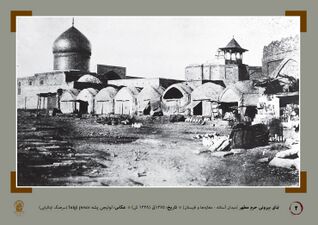 Exterior view of the Holy Shrine of Fatimah Ma'sumah (S.A.) from Astaneh Square (1859 CE).
 -
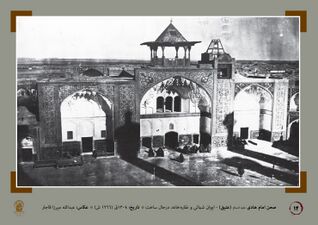 Atiq Courtyard and Naqqareh Khaneh (1887 CE).
 -
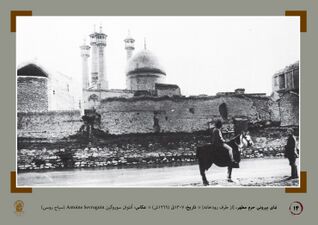 Exterior view of the Holy Shrine of Fatimah Ma'sumah (S.A.) from Qom River and the high walls built to prevent floods from entering the shrine (1890 CE).
 -
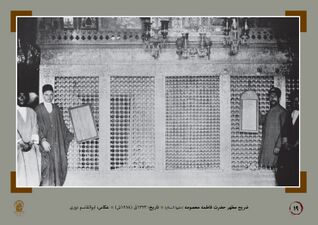 Zarih of the tomb of Fatimah Ma'sumah (S.A.) (1905 CE).
 -
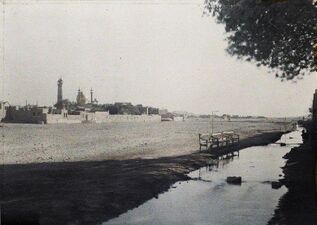 Distant view of the Holy Shrine of Fatimah Ma'sumah (S.A.) (1927 CE).
 -
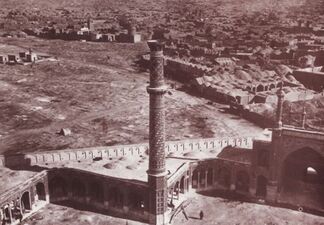 A view of a part of Atabaki Courtyard.
 -
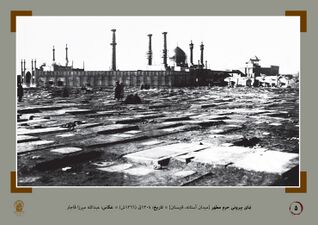 Exterior view of the Holy Shrine of Fatimah Ma'sumah from Astaneh Square (1887 CE).
 -
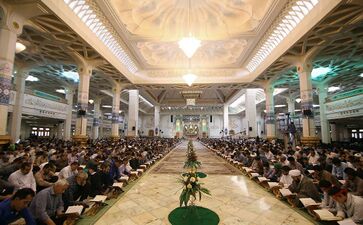 Group Quran recitation in Imam Khomeini Shabestan of the Holy Shrine of Fatimah Ma'sumah (S.A.).
 -
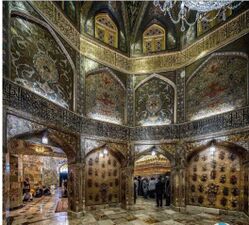 A view of one of the porticos of the Holy Shrine of Fatimah Ma'sumah (S.A.).
 -
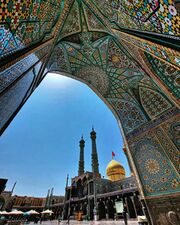 A view of the dome and minarets of Atabaki Courtyard of the Holy Shrine of Fatimah Ma'sumah (S.A.).


References
- ↑ قمی، عباس بن محمدرضا، منتهیالآمال فی تواریخ النبی و الآل، قم، دفتر نشر اسلامی، ج۲، ص۳۷۸.
- ↑ اسحاقی، سیدحسین، مهتاب اهلبیت (سیری در زندگی کریمهٔ اهلبیت حضرت معصومه)، قم، مرکز پژوهشهای اسلامی صدا و سیما، ۱۳۸۶ش، ص۳-۶.
- ↑ محمدی اشتهاردی، محمد، حضرت معصومه(س) فاطمۀ دوم، قم، نشر اخلاق، ۱۳۸۰، ص۱۷۸-۱۷۹.
- ↑ المجلسی، بحار الانوار الجامعة لدرر الاخبار الائمة، بیروت، دار إحياء التراث العربی، ۱۴۰۳ق، ج۵۷، ص۲۲۸.
- ↑ محمدی اشتهاردی، حضرت معصومه(س) فاطمۀ دوم، ص۱۷۸-۱۷۹.
- ↑ محمدی اشتهاردی، محمد، «حضرت معصومه(س)،اختر تابان آل محمد(ص)»، نشریۀ پاسدار اسلام، ش۱۷۷، ۱۳۵۷.
- ↑ محمدی اشتهاردی، حضرت معصومه(س) فاطمۀ دوم، ص۱۵۹.
- ↑ ابنقولویه، جعفر بن محمد، کامل الزیارات، تحقیق عبدالحسین امینی، نجف، دار المرتضوية، ص۳۲۴.
- ↑ د ځینو نمونو د معلوماتو لپاره وګورئ: محمدی اشتهاردی، محمد، «حضرت معصومه(س)،اختر تابان آل محمد(ص)».
- ↑ قمی، عباس بن محمدرضا، الفوائد الرضویة في أحوال علماء المذهب الجعفریة، تحقیق ناصر باقری بیدهندی، قم، بوستان کتاب، ۱۳۸۵، ص۶۱۸.
- ↑ قمی، منتهیالآمال، ج۲، ص۳۷۸؛ همدارنګه: قمی، عباس بن محمدرضا، مفاتیح الجنان، قم، انتشارات اسوه، بېتا، ص ۵۶۲.
- ↑ د مفصلو معلوماتو لپاره وګورئ: محمدی اشتهاردی، حضرت معصومه(س) فاطمۀ دوم، ص۱۹۱-۲۱۹.
- ↑ صادقی اردستانی، احمد، زنان دانشمند و راوی حدیث، قم، مرکز انتشارات دفتر تبلیغات اسلامی، ۱۳۷۷، ص۳۵۰-۳۵۱.
- ↑ ابن الجزری، محمد بن محمد، أسنى المطالب فى مناقب الإمام على(ع)، اصفهان، مکتبة الإمام أميرالمؤمنين علی(ع) العامة، ص۵۰-۵۱.
- ↑ القمی، عباس بن محمدرضا، سفینة البحار و مدینة الحکم و الآثار، تهران، دارالاسرة للطباعة و النشر، ۱۳۹۲، ج۴، ص۵۴۵.
- ↑ نائینی اردستانی، محمدعلی بن حسین، انوار المشعشعین، تحقیق محمدرضا انصاری قمی، قم، کتابخانهٔ بزرگ حضرت آیتالله العظمی مرعشی نجفی، ج۱ ، ص۲۱۱؛ همدارنګه: رفیعی، علی، تاریخ زندگانی امام کاظم(ع)، تهران، سپاه پاسداران انقلاب اسلامی، نمایندگی ولی فقیه، اداره آموزشهای عقیدتی سیاسی، ص۲۱.
- ↑ رفیعی، تاریخ زندگانی امام کاظم(ع)، ص۲۱.
- ↑ رفیعی، تاریخ زندگانی امام کاظم(ع)، ص۲۱.
- ↑ رفیعی، تاریخ زندگانی امام کاظم(ع)، ص۲۱.
- ↑ Mahallati, Riyāḥīn al-Sharīʿah, vol. 5, p. 31.
- ↑ From Birth to Death, Comprehensive Portal of the Holy Shrine of Lady Fatimah Ma'sumah (s), Date of publication: 1398, Date of visit: 1401.
- ↑ A group of authors, Encyclopedia of Imam Kazim (a), undated, Ashura Specialized Website, undated, p. 338.
- ↑ Elhami, Davood, A Journey through the History of Shi'ism, Qom, Maktab Islam, 1375, p. 545.
- ↑ Hosseini, Seyyed Javad, "The Secret of Lady Ma'sumah's (s) Unmarried Status," Farhang Kowsar, 1386, no. 69.
- ↑ Faghihi, Ali-Asghar, Religious History of Qom, Qom, Zaer Publications, 1387, p. 92.
- ↑ From Birth to Death, Comprehensive Portal of the Holy Shrine of Lady Fatimah Ma'sumah (s), Date of publication: 1398, Date of visit: 1401.
- ↑ Rafiei, History of the Life of Imam Kazim (a), pp. 24-25.
- ↑ 23 Rabi' al-Awwal, Anniversary of the Arrival of Lady Fatimah Ma'sumah (s), Library of Faqahat School, Date of publication: 1396, Date of visit: 1401.
- ↑ Tashid, Ali-Akbar, Hadyah Isma'il or the Uprising of the Alawi Sayyids for the Caliphate, Tehran, Dar al-Kutub al-Islamiyah, 1385 SH, p. 166.
- ↑ Pak, Mohammad Reza, "Qom in the First Two Centuries of Hijra," History of Islam, Islamic Propagation Office of Qom Seminary, 1382, no. 14, p. 10.
- ↑ کينډۍ:Journal citation
- ↑ Ibn Qulawayh, Ja'far ibn Muhammad, Kamil al-Ziyarat, Najaf Ashraf, Dar al-Murtadawiyyah, first edition, 1356 AH, Chapter 106, p. 324, Hadith 1.
- ↑ Ibn Babawayh, Muhammad ibn Ali, Uyun Akhbar al-Reza (PBUH), Tehran, Nashr Jahan, first edition, 1378 AH, Chapter 67, vol. 2, p. 267, Hadith 1.
- ↑ Ibn Qulawayh, Ja'far ibn Muhammad, Kamil al-Ziyarat, Najaf Ashraf, Dar al-Murtadawiyyah, first edition, 1356 AH, Chapter 106, p. 324, Hadith 2.
- ↑ Al-Majlesi, Bihar al-Anwar, vol. 99, pp. 266-267; also: Al-Majlesi, Muhammad Baqir, Tuhfat al-Za'ir, Qom, Imam Hadi (PBUH) Institute, 1386 AH, p. 4; also: Al-Majlesi, Zad al-Ma'ad, Beirut, Mu'assasat A'lami lil Matbu'at, 1423 AH, pp. 548-547.
- ↑ Al-Majlesi, Bihar al-Anwar, vol. 99, pp. 266-267.
- ↑ Kiani, Yousef, "The Complex of Lady Masoumeh's Shrine (PBUH)", Faculty of Literature and Humanities, University of Tehran, No. 151, Autumn 1999, p. 64.
- ↑ Sajjadi, Sadegh, "The Shrine of Lady Masoumeh", The Great Islamic Encyclopedia, Tehran, Center for the Great Islamic Encyclopedia, vol. 1, p. 360.
- ↑ Sajjadi, "The Shrine of Lady Masoumeh", The Great Islamic Encyclopedia, vol. 1, pp. 358-362.
- ↑ Sotoudeh, Manouchehr, Books of the Holy Shrine of Lady Masoumeh (PBUH) and its surrounding courtyards, Qom, Library of Grand Ayatollah Marashi Najafi, 1375 AH, p. 19.
- ↑ Rezaei Nodoushan, "The Evolution of Lady Masoumeh's Shrine", Iranian Architectural Studies, p. 92.
- ↑ ۴۲٫۰ ۴۲٫۱ Sajjadi, "The Shrine of Lady Masoumeh", The Great Islamic Encyclopedia, vol. 1, p. 359.
- ↑ Vazin Afzal, Mehdi, "The Expansion of Lady Masoumeh's Shrine and the Increase of Pilgrims to Qom during Naser al-Din Shah's Reign, Research in History, Second Year, No. 3, Autumn 2011, p. 65.
- ↑ ۴۴٫۰ ۴۴٫۱ ۴۴٫۲ "Lady Masoumeh's Shrine", Reisen Iran website, date of article: June 3, 2022, date of visit: January 4, 2023.
- ↑ Sajjadi, "The Shrine of Lady Masoumeh", The Great Islamic Encyclopedia, vol. 1, p. 360.
- ↑ Sajjadi, "The Shrine of Lady Masoumeh", The Great Islamic Encyclopedia, vol. 1, pp. 360-361.
- ↑ "Lady Masoumeh's Shrine" Reisen Iran website.
- ↑ "Lady Masoumeh's Shrine" Reisen Iran website.
- ↑ Sajjadi, "The Shrine of Lady Masoumeh", The Great Islamic Encyclopedia, vol. 1, pp. 360-361.
- ↑ Sajjadi, "The Shrine of Lady Masoumeh", The Great Islamic Encyclopedia, vol. 1, pp. 359-360.
- ↑ "Historical overview of the holy zarih of Lady Masoumeh (PBUH) from beginning to present", ISNA, date of article: August 10, 2016, date of visit: January 1, 2023.
- ↑ Sajjadi, "The Shrine of Lady Masoumeh", Center for the Great Islamic Encyclopedia, vol. 1, p. 360.
- ↑ Nodoushan, Mohammad Rezaei, "The Evolution of Lady Masoumeh's Shrine", Iranian Architectural Studies, No. 16, Autumn and Winter 2019, p. 92.
- ↑ ""The Holy Shrine of Lady Masoumeh (PBUH) (Qom)", Islamic Teachings (Endowments Organization), No. 29, September 1978, p. 56.
- ↑ Sajjadi, "The Shrine of Lady Masoumeh", The Great Islamic Encyclopedia, vol. 1, p. 360.
- ↑ Faqih Mirzayi, Hossein, "Renovation plan for the holy dome of Lady Fatima Masoumeh (PBUH)", Hawzah Information Base, date of article: April 21, 2003, date of visit: January 3, 2023.
- ↑ "History of Lady Masoumeh's Shrine (PBUH)", Hawzah Information Base, date of article: July 15, 2018, date of visit: December 31, 2022.